Hindu Gods and Goddesses
Christians despict God as a tall white bearded man in his later years. The gods of the Hindu's are usually portrayed as young, for they never grow old. Their bodies not being of ordinary flesh and blood but mear vehicles for the devine spirit. The presence of 4 or more arms is a show of the Gods greater power over man. Modern Hindus gods and goddesses are rarely shown not smiling affectionately upon devotees. Dressed sumptuously or sometimes scantily, they wore bright clothes and rich jewelry. With 300,000 Gods and Goddesses, stories of a complex religion of myths and legends, full of symbolism and mystical philosophy comes forth.
(Reference: Hindu Epics, Myths and Legends in Poplar Illustrations, by Vassilis G. Vitsaxis)
The Supreme Triad consists of three great gods: Braham, Vishnu, and Shiva. This Triad represents all aspects of the Supreme Being. Much like the Christian trinity of God as the Father, Son and Holy Ghost. In this regard they are sometimes called Sat-Tat-Aum.
Brahma was initially worshipped on the same level as the other two gods but over time became a lesser god. Vishnu rose to the highest level in the triad before the end of Vedic times with Shiva being the third member of the Supreme Triad.
Hindu Gods


Vishnu - god of duration, preservation of the cycle.
Vishnu contains every possible contradiction and in consequence is therefore the great and complete god. The sacred writ states that Vishnu is 'the infinite ocean of the Universe', from which the entire world springs forth. Vishnu is often seen richly dressed and having four arms. Also on his forehead you may find incscribed a symbol in the shape of a U. This god always carries his symbols in his hands for easy recognition. Vishnu's moount is an enormous eagle, Garuda.
Brahma - the creator, is described as 'the first cause in the Universe'.
Brahma is the son of the Supreme Being. Brahma's only task was creator, never destroying what he creates. This singular task makes him a lesser god than the two others of the supreme triad. According to the myths, Brahma originally possessed only one head. He acquired the other heads when woman was created (much list Eve created out of Adam's rib). His love for her (woman) caused him to follow her wherever she moved. Causing the heads to grow, facing each direction, to follow her. When she (woman) rose into the sky in despair of his ever watching eyes, a fifth head grew. Finally when God Brahma joined her, the human race was created. Brahma's mount is a goose.
Shiva - god of constant change, god of destruction, end of a particular creation and condition for appearance of a new one.
Shiva, also known as the 'good One' or Mahadeva the 'Greatest' or 'Great God'. This god is more complex, 'many sided' than Vishnu. Shiva can be seen sitting upon a skin of a tiger or a panther, or with three white horizontal stripes upon his forehead. The Mahabharata tells a story of Shiva's vertical third eye...... Once during meditation upon the Himalayas, his consort Uma came softly near him and playfully covered his eyes with her two hands. What happened was terrifying. The whole world was plunged into darkness. Suddenly, a great flame sprand from the forehead of the god, at the base of which appeared an eye, as brilliant as the sun, which gave light again to the world. Shiva's mount is a bull, Nandi.
Hindu Goddesses
Other Gods:
Other Godesses:
Parvati - second consort of Shiva, she reflects the gentle aspects of Shiva's character and qualities.
Mother to Ganesh.
Gayatri - is an incarnation of Saraswati Devi, consort of Lord Brahma, symbolising the strength and quality of Knowledge, Purity and Virtue. She is the feminine form of gāyatra, a Sanskrit word for a song or a hymn.
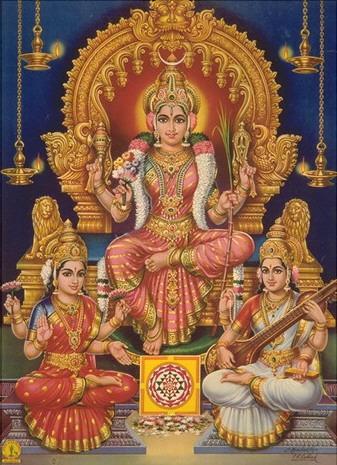
The Tridevi or triad goddesses of Hinduism have equal importance as the trimurti or Supreme triad.
Kali - another Shiva consort form, reflects the fiercer elements. The mysterious goddess.
Ganesh - son of Shiva and Parvati
Sarasvati - Brahma's consort is identified as the goddess of the river, of speech, of wisdom and culture (arts and music). The Goddess of Education.
Durga - Shiva's consort is identified as the goddess of energy, she is the all powerful warrior who fights demons. The Goddess of Destruction.
Om Shanti Mandiram
Lakshmi - Vishnu's consort is identified as the goddess of beauty, good luck and wealth.
The Goddess of Prosperity.
Hanuman - is the incarnation or reflection of Shiva
Krishna - is the eighth avatar of the Vedic Supreme God Vishnu. The word Krishna means one with dark complexion and one who attracts all.
